Early and Late Outcomes Among Patients Undergoing Carotid Endarterectomy with a Contralateral Internal Carotid Artery Occlusion or Severe Stenosis
| Available Online: | July, 2026 |
| Page: | 48–52 |
Author for correspondence:
George Galyfos
email: georgegalyfos@hotmail.com
Address: 114 Vasilissis Sofias Avenue, Athens, Greece, 11527
Tel.: +30 2132088132
Fax: +30 2107707574
ORCID ID: 0000-0002-6077-007X
Doi 10.59037/2xsnjf31
Full Text
Gallery
Full Text
Abstract:
Introduction: The role of prophylactic carotid endarterectomy (CEA) in asymptomatic octagenarians remains controversial. However, a contralateral internal carotid artery (ICA) occlusion or severe stenosis may be associated with a higher stroke risk among these patients. Aim of this study is to evaluate early and late outcomes among patients with severe contralateral ICA disease, and to further compare outcomes between asymptomatic patients older and younger than 80 years of age.
Methods: This was a retrospective study. All patients with a contralateral ICA occlusion or ≥80% stenosis undergoing CEA in our Vascular Unit within five years (01/2020-12/2024) were included. All basic characteristics were recorded. Early and late outcomes were evaluated. All outcomes were also compared between asymptomatic patients ≥ and < 80 years old.
Results: In total, 47 patients (18 with a contralateral ICA occlusion and 29 with a contralateral ≥80% ICA stenosis) were included. Mean stenosis of the treated carotid artery was 82±7%. Overall, 42% (n=20) of patients were symptomatic (11 transient ischemic attacks (TIAs) and 9 strokes). Regarding early outcomes, mortality was null, stroke rate was null, TIA rate was 4%, bleeding/major hematoma rate was 4%, cranial nerve injury was 4% and symptomatic myocardial infarction rate was 4%. Within a mean follow-up of 22 ± 4 months, no new stroke or TIA was reported. Eight late deaths of other causes were observed. When asymptomatic patients <80 years old (n=18) were compared with asymptomatic patients ≥80 years old (n=9), perioperative outcomes were not different.
Conclusion: Early and late outcomes after CEA are acceptable among patients with a severe contralateral ICA disease. Asymptomatic patients over 80 years old with a severe contralateral ICA disease seem to have similar outcomes compared to younger patients. Therefore, surgery should be considered for eligible older patients within this high-risk subgroup.
Keywords: contralateral occlusion; internal carotid artery stenosis; asymptomatic; octagenarians
INTRODUCTION
According to recent guidelines on proper management of atherosclerotic carotid disease, asymptomatic patients with >60% internal carotid artery (ICA) stenosis should preferably be treated conservatively.1 Especially for octagenarians, the role of prophylactic carotid endarterectomy (CEA) remains controversial. There are, however, some specific factors that could increase the risk for stroke and suggest a benefit from carotid intervention. Such factors include contralateral ICA occlusion or severe contralateral stenosis.2 Octagenarians have long been considered of high risk for any intervention and have been excluded from the NASCET (North American symptomatic carotid endarterectomy trial) and ACAS (asymptomatic carotid atherosclerosis study) trials.3-5 Additionally, these trials have recruited a relatively small number of patients with contralateral occlusion or severe contralateral ICA stenosis.4,5
Therefore, aim of this study is to evaluate early and late outcomes in a series of patients with contralateral carotid occlusion or severe contralateral stenosis undergoing CEA. The effect of increased age over 80 years old among asymptomatic patients will be also evaluated among these patients.
METHODS
In this retrospective study, all patients undergoing a CEA with contralateral ICA occlusion or contralateral significant ICA stenosis (≥80%) were included. All patients were treated in our Vascular Unit, within a 5-year period (01/2020 – 12/2024). Main indication for CEA in our institution includes a symptomatic ICA stenosis >50% or an asymptomatic stenosis >60% with high-risk characteristics (such as ultrasonographic characteristics of higher risk or contralateral occlusion). Ultrasonographic plaque characteristics suggestive of higher risk include intraplaque hemorrhage, ulcerative plaque or high echolucency, according to recent guidelines.1
All basic characteristics of patients were recorded including gender, mean age, main comorbidities and antithrombotic treatment. Technical characteristics, early and late outcomes were also evaluated. Technical characteristics included the type of patch, the type of CEA (traditional or eversion) and the use of shunt. Early outcomes included 30-day death, transient ischemic attack (TIA), stroke, bleeding/hematoma, cranial nerve injury and symptomatic myocardial infarction (MI) rates. Late outcomes included death and TIA/stroke rates within the follow-up period. Additionally, all outcomes were compared between asymptomatic patients <80 years old and ≥80 years old. Bleeding/hematoma was defined as any bleeding or hematoma that required blood transfusion or re-operation. Symptomatic MI was defined as any ischemic symptoms combined with alteration on electrocardiogram (ECG) or serum troponin elevation. Cranial nerve injury included any hoarseness, swallowing difficulty, tongue deviation or other symptom attributed to injury of major cranial nerves.
All patients were treated according to the Declaration of Helsinki. No special approval was required by the Institutional Review Board of our institution as this was a retrospective study.
Statistical analysis was conducted using the StatsDirect Statistical software (Version 2.8.0, StatsDirect Ltd, Cambridge, UK). Quantitative variables are presented with mean values and qualitative variables with absolute numbers and rates. Values were compared between groups using the exact Fisher test. P values < 0.05 were considered of statistical significance.
RESULTS
In this study, a total of 47 patients (18 patients with contralateral ICA occlusion and 29 patients with contralateral ≥80% ICA stenosis) were included. Overall, 74% of patients were of male gender and 34% of patients were ≥80 years old. Overall, 42% (n=20) of patients were symptomatic (n=9 with stroke and n=11 with TIA/amaurosis fugax).
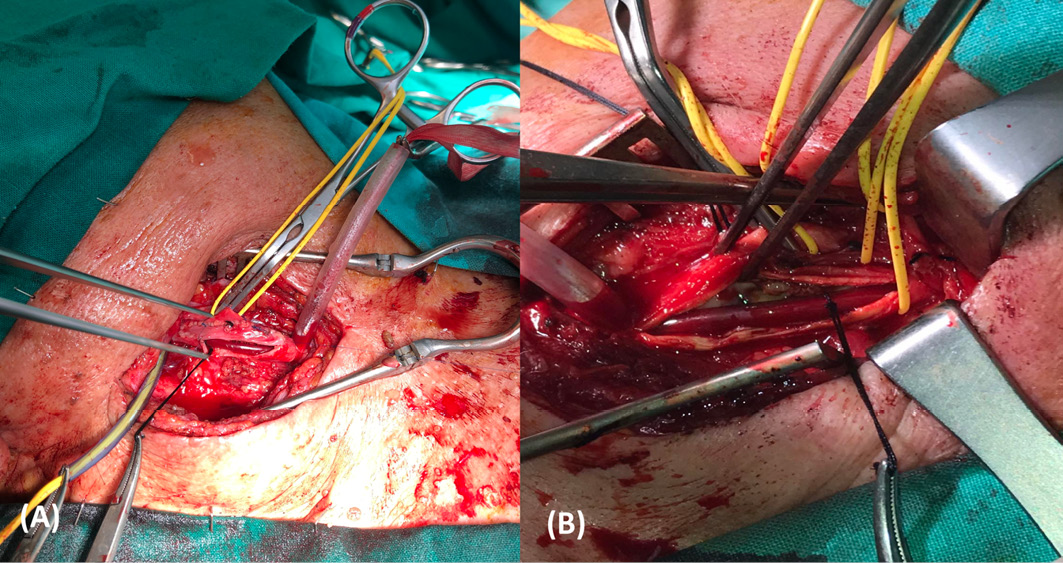
The following comorbidities were recorded: Smoking history (75%), Arterial hypertension (74%), Dyslipidemia (83%), Diabetes mellitus (21%), Coronary artery disease (33%), Chronic obstructive pulmonary disease (15%). The following antithrombotic treatment was recorded: ASA (n=23, 49%), Clopidogrel (n=18, 38%), dual antiplatelet (n=6, 13%). Regarding the technical characteristics, a venous patch was used in 6 cases (13%), a bovine patch in 30 cases (64%), a polytetrafluoroethylene (PTFE) patch in 10 cases (21%), an eversion technique was performed in 1 case (2%) and a shunt was placed in 68% of cases (Table 1, Fig. 1).
Thirty-day outcomes included 0% death rate, 0% stroke rate, 4% (n=2) TIA rate, 4% (n=2) bleeding/hematoma rate, 4% (n=2) cranial nerve injury rate and 4% (n=2) symptomatic MI rate. Regarding bleeding, one case was re-operated within the first postoperative day due to bleeding through a suture-line defect and one case was re-operated after 2 weeks due to a persistent neck hematoma under dual antiplatelets. All cranial nerve injuries were referring to hoarseness that subsided within the following 6 months (Table 2).
Within a mean follow-up of 22 ± 4 months, no new ipsilateral cerebrovascular event occurred. Eight late deaths occurred during the follow-up that were not related to the carotid disease.
Out of the 27 asymptomatic patients, 18 patients were <80 years old and 9 patients were ≥80 years old. Early and late outcomes were not different between the two groups (Table 3).
DISCUSSION
In this study, we found that both early and late outcomes are satisfying among patients with contralateral ICA occlusion or contralateral severe ICA stenosis undergoing CEA. Furthermore, age over 80 years old did not affect outcomes among asymptomatic patients with severe contralateral ICA disease.
To date, many studies have underlined the higher stroke risk associated with a contralateral ICA occlusion among patients with an ICA stenosis. AbuRhama et al. have found that patients with 60% to 70% ICA stenosis and contralateral ICA occlusion have a higher incidence of ipsilateral stroke as well as any stroke.6 Therefore, performing a prophylactic CEA in those patients may be justified. The recent European guidelines on carotid artery disease management have also included the contralateral ICA occlusion among the risk factors to recommend an intervention in an asymptomatic patient with carotid artery stenosis.1
The status of contralateral ICA and its effect on outcomes after CEA has also been studied in literature. Data from the ACAS (Asymptomatic Carotid Atherosclerosis Study) and the NASCET (North American Symptomatic Carotid Endarterectomy Trial) trials suggest that contralateral ICA occlusion is a predictor of poor outcomes after CEA.4,5 However, there has been a controversy lately about whether this factor is associated with adverse outcomes post CEA. A recent meta-analysis has showed that contralateral ICA occlusion is associated with a higher risk for perioperative neurological complications although there is no significant effect on perioperative mortality and 5-year stroke-free survival.7 This concurs with our findings as the 4% stroke/TIA rate in the present cohort is higher than the overall rate among cases with or without contralateral disease treated in our unit as published before.8 Additionally, the present cohort showed very low early mortality and long-term ipsilateral stroke/TIA rates concurring with previous published data.8 Finally, outcomes seem to be similar between CEA and CAS among patients with contralateral occlusion, even among asymptomatic patients.9 However, another meta-analysis has shown that CEA in patients with contralateral carotid occlusion is associated with an increased risk of perioperative stroke, death or TIA, while CAS in the presence of a contralateral occlusion is associated with an increased risk of periprocedural death but not stroke or TIA.10
Regarding the procedure, it has been found that patients with significant contralateral disease, namely occlusion or >70% stenosis, are correlated with a poor collateral perfusion pressure and require shunt placement during CEA.11 The presence of cross-filling also plays an important role for the requirement of shunt in such patients. In this cohort, almost 70% of patients underwent a shunt placement concurring with previous series where over half of the cases with severe contralateral ICA disease needed a shunt.7,12 Other factors associated with adverse neurological events among such patients with contralateral disease include female gender, preoperative symptoms, advanced age and severe renal insufficiency.13-15
In this study, preoperative symptoms did not affect outcomes after CEA. Furthermore, age >80 years old did not increase the risk for perioperative complications among asymptomatic patients with severe contralateral disease. This concurs with larger studies where symptomatic and asymptomatic patients with contralateral carotid occlusion had similar perioperative outcomes after CEA.16 Additionally, Qumsiyeh et al. have compared outcomes of CEA between patients below and over 80 years of age.17 Both age groups showed similar stroke rates after surgery and age >80 years old did not affect outcomes as well. Similarly, Ballotta et al. evaluated outcomes of octagenarians with contralateral disease undergoing CEA and found a very low neurological complications rate concurring with our findings.18 Another large study showed that perioperative outcomes in asymptomatic patients aged ≥80 years with a contralateral ICA occlusion were similar to those in patients aged <80 years, validating the rationale to consider surgery in eligible older asymptomatic patients at elevated stroke risk.19
There are certain limitations in this study. First, this is a retrospective study, and there may be certain risks of bias considering patients’ selection, shunt selection as well as the medical treatment. Second, the number of patients compared in each group was small and this could affect the level of significance for the analysis. Third, the small number of patients precluded the conduct of any multivariate analysis in order to evaluate potential predictors.
In conclusion, early and late outcomes after CEA are acceptable among patients with a severe contralateral ICA disease. Asymptomatic patients over 80 years old with a severe contralateral ICA disease seem to have similar outcomes compared to younger patients. Therefore, surgery should be considered for eligible older patients within this high-risk subgroup.
REFERENCES
- Naylor R, Rantner B, Ancetti S, de Borst GJ, De Carlo M, Halliday A, et al. Editor’s Choice – European Society for Vascular Surgery (ESVS) 2023 Clinical Practice Guidelines on the Management of Atherosclerotic Carotid and Vertebral Artery Disease. Eur J Vasc Endovasc Surg. 2023;65:7-111.
- Reiff T, Eckstein HH, Mansmann U, Jansen O, Fraedrich G, Mudra H, et al; SPACE-2 Investigators. Contralateral Stenosis and Echolucent Plaque Morphology are Associated with Elevated Stroke Risk in Patients Treated with Asymptomatic Carotid Artery Stenosis within a Controlled Clinical Trial (SPACE-2). J Stroke Cerebrovasc Dis. 2021;30:105940.
- Miller MT, Comerota AJ, Tzilinis A, Daoud Y, Hammerling J. Carotid endarterectomy in octogenarians: does increased age indicate “high risk?”. J Vasc Surg. 2005;41:231-7.
- Baker WH, Howard VJ, Howard G, Toole JF. Effect of contralateral occlusion on long-term efficacy of endarterectomy in the asymptomatic carotid atherosclerosis study (ACAS). ACAS Investigators. Stroke. 2000;31:2330-4.
- Ferguson GG, Eliasziw M, Barr HW, Clagett GP, Barnes RW, Wallace MC, et al. The North American Symptomatic Carotid Endarterectomy Trial: surgical results in 1415 patients. Stroke. 1999;30:1751-8.
- AbuRahma AF, Metz MJ, Robinson PA. Natural history of > or =60% asymptomatic carotid stenosis in patients with contralateral carotid occlusion. Ann Surg. 2003;238:551-62.
- Cheng W, Lu H, Hu Y. Influence of Contralateral Carotid Occlusion on Outcomes After Carotid Endarterectomy: A Meta-Analysis. J Stroke Cerebrovasc Dis. 2018;27:2587-2595
- Galyfos G, Tsioufis C, Theodorou D, Katsaragakis S, Zografos G, Filis K. Cardiac troponin I after carotid endarterectomy in different cardiac risk patients. J Stroke Cerebrovasc Dis. 2015;24:711-7.
- Texakalidis P, Giannopoulos S, Kokkinidis DG, Karasavvidis T, Rangel-Castilla L, Reavey-Cantwell J. Carotid Artery Endarterectomy Versus Carotid Artery Stenting for Patients with Contralateral Carotid Occlusion: A Systematic Review and Meta-Analysis. World Neurosurg. 2018;120:563-571.
- Kokkinidis DG, Chaitidis N, Giannopoulos S, Texakalidis P, Haider MN, Aronow HD, et al. Presence of Contralateral Carotid Occlusion Is Associated With Increased Periprocedural Stroke Risk Following CEA but Not CAS: A Meta-analysis and Meta-regression Analysis of 43 Studies and 96,658 Patients. J Endovasc Ther. 2020;27:334-344.
- AbuRahma AF, Mousa AY, Stone PA, Hass SM, Dean LS, Keiffer T. Correlation of intraoperative collateral perfusion pressure during carotid endarterectomy and status of the contralateral carotid artery and collateral cerebral blood flow. Ann Vasc Surg. 2011;25:830-6.
- Patel PB, LaMuraglia GM, Lancaster RT, Clouse WD, Kwolek CJ, Conrad MF, et al. Severe contralateral carotid stenosis or occlusion does not have an impact on risk of ipsilateral stroke after carotid endarterectomy. J Vasc Surg. 2018;67:1744-1751.
- Dalainas I, Nano G, Bianchi P, Casana R, Malacrida G, Tealdi DG. Carotid endarterectomy in patients with contralateral carotid artery occlusion. Ann Vasc Surg. 2007 Jan;21:16-22.
- Capoccia L, Sbarigia E, Rizzo AR, Pranteda C, Menna D, Sirignano P, et al. Contralateral occlusion increases the risk of neurological complications associated with carotid endarterectomy. Int J Vasc Med. 2015;2015:942146.
- Kretz B, Abello N, Astruc K, Terriat B, Favier C, Bouchot O, et al. Influence of the contralateral carotid artery on carotid surgery outcome. Ann Vasc Surg. 2012;26:766-74.
- Rockman CB, Su W, Lamparello PJ, Adelman MA, Jacobowitz GR, Gagne PJ, et al. A reassessment of carotid endarterectomy in the face of contralateral carotid occlusion: surgical results in symptomatic and asymptomatic patients. J Vasc Surg. 2002;36:668-73.
- Qumsiyeh Y, Siada S, Yan Y, Dirks R, Ali A, Daneshvar M, et al. Carotid endarterectomy is safe for octogenarians. J Vasc Surg. 2023;77:176-181.
- Ballotta E, Renon L, Da Giau G, Barbon B, Terranova O, Baracchini C. Octogenarians with contralateral carotid artery occlusion: a cohort at higher risk for carotid endarterectomy? J Vasc Surg. 2004;39:1003-8.
- Eid MA, Columbo JA, Perry I, Neal D, Huber TS, Upchurch GR Jr, et al. Surgical intervention among asymptomatic patients aged ≥80 with a contralateral carotid occlusion appears selectively warranted. J Vasc Surg. 2025;82:2069-2078.