What Is the Best Option for Non-Infected Proximal Failure After EVAR? Open Conversion
| Available Online: | July, 2026 |
| Page: | 57–60 |
Author for correspondence:
Andreas M. Lazaris
1st Vascular Surgery Department, School of Medicine, National and Kapodistrian University of Athens, Attikon University Hospital, Athens, Greece
email: andreas.lazaris@gmail.com
DOI 10.59037/32pr1776
Full Text
Gallery
Full Text
Abstract:
Endovascular aneurysm repair (EVAR) has changed the treatment of abdominal aortic aneurysms by reducing early perioperative morbidity and mortality compared with open repair. Its long-term durability, however, depends on a stable proximal seal, secure fixation, and careful follow-up. Non-infected proximal failure after EVAR – type Ia endoleak, migration, neck dilatation, graft malapposition, or sac expansion – is not a minor imaging finding. It indicates failure of the central purpose of EVAR: exclusion of the aneurysm sac from systemic pressure. Secondary endovascular treatment with cuffs, endoanchors, parallel grafts, or fenestrated/branched repair is valuable in selected patients, especially those at prohibitive operative risk. However, in physiologically fit patients with complex, recurrent, or anatomically unsuitable proximal failure, open conversion remains the most definitive option. The essential point is timing. Elective open conversion has acceptable results in experienced centers, whereas delayed conversion after rupture or repeated failed endovascular attempts carries substantially higher risk. Open conversion should therefore not be reserved only as a final bailout procedure but considered early when it offers the best chance of durable repair.
EVAR was introduced as a less invasive alternative to open abdominal aortic aneurysm repair. Its early advantages are well known: lower perioperative mortality and faster recovery in appropriately selected patients.1,2 However, EVAR does not remove the aneurysm. It excludes it. The success of the operation, therefore, depends on something that may change with time: the relationship between the endograft and the native aortic neck.
Non-infected proximal failure is one of the most important late problems after EVAR. It may present as type Ia endoleak, proximal migration, neck enlargement, graft malapposition, or sac expansion. Forbes et al. showed early on that most late open conversions were performed for persistent aneurysm perfusion, highlighting that the real problem is failure of sac exclusion.3 A type Ia endoleak is very different from a low-flow type II endoleak. It reflects direct systemic pressurization of the aneurysm sac and is associated with continued expansion and rupture risk.4,5 Hostile neck anatomy and progressive neck dilatation are recognized mechanisms that lead to loss of seal, migration, and late failure.6,7 The 2024 European Society for Vascular Surgery guidelines recognize a compromised proximal seal after EVAR as a clinically important problem and state that elective open conversion may be considered in selected patients.8
In a debate on failed EVAR, technical feasibility is not enough. A further endovascular maneuver may look attractive, particularly because it avoids laparotomy and aortic clamping. The more important question is whether it offers a durable solution for the individual patient. For a fit patient with non-infected proximal failure, open conversion corrects the failed repair directly and restores aneurysm exclusion through surgical reconstruction.
Endovascular options for proximal failure include balloon molding, proximal cuffs, endoanchors, chimney or parallel graft techniques, and fenestrated or branched repair. These methods are important and, in many patients, entirely appropriate. Frail patients, those with hostile abdomens, or patients with prohibitive cardiopulmonary risk may benefit most from an endovascular strategy. Fenestrated and branched repair has also expanded the possibilities for treating failed infrarenal EVAR by moving the seal zone into the pararenal or visceral aorta.9
Nevertheless, the ability to perform another endovascular procedure should not be confused with the ability to provide a durable repair. Secondary endovascular repair may convert an infrarenal problem into a paravisceral reconstruction requiring fenestrations, branches, bridging stents, and continued surveillance. Endoanchors may improve fixation and sealing in selected cases, but they cannot reliably compensate for severe neck degeneration, major migration, or absence of an adequate landing zone.10 Parallel graft strategies may be useful in urgent or constrained anatomy, but the risk of gutters, recurrent endoleak, and reintervention remains a concern. Contemporary meta-analytic data suggest that fenestrated and branched endovascular repair can provide an effective rescue option for proximal endograft failure after EVAR, with high technical success and acceptable early mortality; however, midterm reintervention rates remain substantial, reinforcing the need to judge endovascular feasibility against expected durability in each patient.11
There is also a practical surgical issue. Repeated endovascular attempts may make later open conversion more difficult. They may extend the metal framework proximally, involve the renal or visceral arteries, increase the complexity of explantation, and remove favorable clamp sites. For this reason, an “endovascular until impossible” strategy may turn a controlled elective conversion into a more complex and hazardous operation.
The appeal of open conversion is simple: it addresses the failed seal directly. Instead of searching for another compromised landing zone, the surgeon re-establishes control of the aorta and reconstructs the aneurysmal segment with a sutured graft. The increasing use of open conversion in contemporary practice should not be seen as a failure of surgery, but as a consequence of the cumulative burden of late EVAR complications. Mohapatra et al. reported an increasing use of open conversion for late EVAR complications and concluded that elective conversion for endoleak is reasonably safe and durable, including when graft-preserving strategies are used.12
The usual objection is operative risk. This concern is real, but timing changes the entire discussion. In the systematic review by Kouvelos et al., which included 641 patients undergoing late open conversion after EVAR, the overall 30-day mortality was 9.1%. However, mortality was 3.2% after elective conversion and 29.2% after nonelective conversion.13 A later systematic review and meta-analysis showed a similar message, with approximately tenfold higher 30-day mortality for urgent compared with elective late open conversion, while elective conversion approached the mortality of primary elective open abdominal aortic aneurysm repair.14
Other data support the same principle. Scali et al. showed that elective open conversion for type Ia endoleak was not associated with increased morbidity or mortality compared with primary open juxtarenal aneurysm repair in selected patients.15 More recently, Kahlberg et al. compared elective late open conversion after EVAR with primary open repair in a high-volume center. After propensity score matching, in-hospital mortality and 30-day reintervention rates were not significantly different between the two groups.16 These studies matter because they challenge the reflex to reserve open conversion until all endovascular options have been exhausted.
The conclusion is not that every proximal failure after EVAR requires open surgery. Rather, the threshold for elective conversion should be lower when the patient is fit, the sac is expanding, the endograft has migrated, the neck has degenerated, or previous endovascular correction has failed. In such cases, another endovascular procedure may delay the definitive solution rather than provide it.
Open conversion is most compelling in patients with acceptable physiological reserve, reasonable life expectancy, and anatomy that makes durable endovascular salvage uncertain. This includes significant sac expansion with type Ia endoleak, major migration, progressive neck degeneration, recurrent proximal failure after prior reintervention, lack of an adequate landing zone, or anatomy unsuitable for a reliable fenestrated or branched repair.
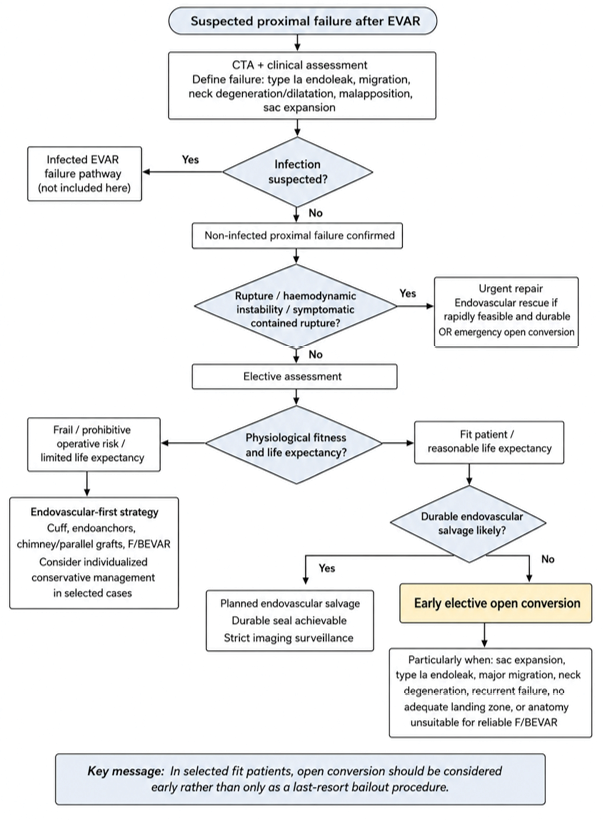
Endovascular salvage remains preferable in many patients: the very elderly, the frail, those with severe cardiopulmonary disease, hostile abdomen, or limited life expectancy. The argument is not open conversion for all. The argument is an open conversion for the patient in whom a definitive surgical repair is safer in the long term than repeated attempts to extend a failing endovascular solution. A practical decision-making algorithm for managing non-infected proximal EVAR failure is shown in Figure 1.
Open conversion after EVAR should be planned as a complex aortic reconstruction. Preoperative computed tomography angiography must define the proximal extent of failure, renal and visceral anatomy, endograft configuration, fixation system, iliac anatomy, and absence of infection. The surgeon should be prepared for suprarenal or supraceliac control, renal protection, difficult iliac reconstruction, and partial or complete endograft explantation.
Importantly, open conversion does not always mean aggressive total explantation. In non-infected cases, partial preservation of incorporated components may reduce operative trauma, particularly when suprarenal fixation is firmly embedded. Recent multicentre data comparing partial and total stent-graft removal during late open conversion for non-infectious EVAR failure showed numerically lower 30-day mortality with partial conversion, similar long-term survival, and similar freedom from late complications.17 No graft infection or thrombosis was reported in the partial-conversion group during follow-up. This supports a pragmatic approach: the objective is durable correction of failed aneurysm exclusion, not removal of every endograft component at all costs. Techniques such as neo-neck or graft-preserving reconstruction have been described to achieve durable repair while avoiding unnecessary injury during explantation.18
Non-infected proximal failure after EVAR is serious because it represents a loss of the central principle of aneurysm exclusion. Endovascular salvage remains valuable, particularly in frail or high-risk patients. However, in a physiologically fit patient with complex, recurrent, or anatomically unsuitable proximal failure, open conversion offers the most definitive and durable repair.
The decisive issue is timing. Elective open conversion in experienced centers can achieve acceptable outcomes and may approach those of primary complex open repair. By contrast, delayed conversion after rupture, instability, or repeated failed endovascular attempts carries substantially higher risk. Open conversion should therefore not be kept only as a last-resort bailout. In selected patients, early planned conversion may be the safest way to restore durable aneurysm exclusion before the situation becomes an emergency. For suitable patients with non-infected proximal EVAR failure, open conversion remains the benchmark against which secondary endovascular solutions should be judged.
REFERENCES
- Greenhalgh R. Comparison of endovascular aneurysm repair with open repair in patients with abdominal aortic aneurysm (EVAR trial 1), 30-day operative mortality results: randomised controlled trial. The Lancet. 2004 Sep;364(9437):843-8. doi:10.1016/S0140-6736(04)16979-1
- Lederle FA. Outcomes Following Endovascular vs Open Repair of Abdominal Aortic AneurysmA Randomized Trial. JAMA. 2009 Oct 14;302(14):1535. doi:10.1001/jama.2009.1426
- Forbes TL, Harrington DM, Harris JR, DeRose G. Late conversion of endovascular to open repair of abdominal aortic aneurysms. Can J Surg. 2012 Aug;55(4):254-8. doi:10.1503/cjs.038310
- Chaikof EL, Blankensteijn JD, Harris PL, White GH, Zarins CK, Bernhard VM, et al. Reporting standards for endovascular aortic aneurysm repair. J Vasc Surg. 2002 May;35(5):1048-60. doi:10.1067/mva.2002.123763
- Schanzer A, Greenberg RK, Hevelone N, Robinson WP, Eslami MH, Goldberg RJ, et al. Predictors of Abdominal Aortic Aneurysm Sac Enlargement After Endovascular Repair. Circulation. 2011 Jun 21;123(24):2848-55. doi:10.1161/CIRCULATIONAHA.110.014902
- AbuRahma AF, Campbell JE, Mousa AY, Hass SM, Stone PA, Jain A, et al. Clinical outcomes for hostile versus favorable aortic neck anatomy in endovascular aortic aneurysm repair using modular devices. J Vasc Surg. 2011 Jul;54(1):13-21. doi:10.1016/j.jvs.2010.12.010
- Cao P, Verzini F, Parlani G, Rango PD, Parente B, Giordano G, et al. Predictive factors and clinical consequences of proximal aortic neck dilatation in 230 patients undergoing abdominal aorta aneurysm repair with self-expandable stent-grafts. J Vasc Surg. 2003 Jun;37(6):1200-5. doi:10.1016/S0741-5214(02)75340-8
- Wanhainen A, Van Herzeele I, Bastos Goncalves F, Bellmunt Montoya S, Berard X, Boyle JR, et al. Editor’s Choice — European Society for Vascular Surgery (ESVS) 2024 Clinical Practice Guidelines on the Management of Abdominal Aorto-Iliac Artery Aneurysms. Eur J Vasc Endovasc Surg. 2024 Feb;67(2):192-331. doi:10.1016/j.ejvs.2023.11.002
- Schanzer A, Beck AW, Eagleton M, Farber MA, Oderich G, Schneider D, et al. Results of fenestrated and branched endovascular aortic aneurysm repair after failed infrarenal endovascular aortic aneurysm repair. J Vasc Surg. 2020 Sep;72(3):849-58. doi:10.1016/j.jvs.2019.11.026
- Jordan WD, Mehta M, Varnagy D, Moore WM, Arko FR, Joye J, et al. Results of the ANCHOR prospective, multicenter registry of EndoAnchors for type Ia endoleaks and endograft migration in patients with challenging anatomy. J Vasc Surg. 2014 Oct;60(4):885-892.e2. doi:10.1016/j.jvs.2014.04.063
- Mylonas SN, Papavlasopoulos V, Moulakakis KG, Kakisis J. Use of Fenestrated/Branched Devices for Rescue of Proximal Endograft Failure After Endovascular Aneurysm Repair: A Systematic Review of the Literature and an Updated Meta-Analysis. J Endovasc Ther. 2025 Mar 13;15266028251325430. doi:10.1177/15266028251325430
- Mohapatra A, Robinson D, Malak O, Madigan MC, Avgerinos ED, Chaer RA, et al. Increasing use of open conversion for late complications after endovascular aortic aneurysm repair. J Vasc Surg. 2019 Jun;69(6):1766-75. doi:10.1016/j.jvs.2018.09.049
- Kouvelos G, Koutsoumpelis A, Lazaris A, Matsagkas M. Late open conversion after endovascular abdominal aortic aneurysm repair. J Vasc Surg. 2015 May;61(5):1350-6. doi:10.1016/j.jvs.2015.02.019
- Goudeketting SR, Fung Kon Jin PHP, Ünlü Ç, De Vries JPPM. Systematic review and meta-analysis of elective and urgent late open conversion after failed endovascular aneurysm repair. J Vasc Surg. 2019 Aug;70(2):615-628.e7. doi:10.1016/j.jvs.2018.11.022
- Scali ST, McNally MM, Feezor RJ, Chang CK, Waterman AL, Berceli SA, et al. Elective endovascular aortic repair conversion for type Ia endoleak is not associated with increased morbidity or mortality compared with primary juxtarenal aneurysm repair. J Vasc Surg. 2014 Aug;60(2):286-294.e1. doi:10.1016/j.jvs.2014.02.046
- Kahlberg A, Galati N, Santoro A, Grignani C, Bugna C, Rinaldi E, et al. A comparison of elective late open surgical conversion after endovascular aneurysm repair versus primary open repair for abdominal aortic aneurysm in a single high-volume center. J Vasc Surg. 2026 Jul;84(1):60-71. doi:10.1016/j.jvs.2026.03.433
- Kaartama T, Esposito D, Pascucci MG, Zacá S, Angiletta D, Civilini E, et al. Long-term results of late open conversions with partial or total removal of noninfected stent grafts after failed endovascular aneurysm repair. J Vasc Surg. 2025 Jun;81(6):1335-42. doi:10.1016/j.jvs.2025.02.023
- Bonvini S, Wassermann V, Menegolo M, Scrivere P, Grego F, Piazza M. Surgical Infrarenal “Neo-neck” Technique During Elective Conversion after EVAR with Suprarenal Fixation. Eur J Vasc Endovasc Surg. 2015 Aug;50(2):175-80. doi:10.1016/j.ejvs.2015.03.027